Street Photography Ideas
Framing
If you wish to communicate ideas of what you saw in front of the camera, frame your photograph carefully - the viewer wasn't with you and doesn't know the experiences attached to the context. This is easy to say, but often difficult to accomplish, as in street photography we have to react and shoot in seconds.
A problem I have had is sometimes looking but not seeing...by this I mean I might concentrate on only part of the frame because it is important to me, but I don't see other items in the frame. When I look at the LCD image, I take in the total frame.
Gil Kreslavsky pointed out that "tighter frames are about emotions of the subject" while "wider frames are about connection of the subject with the environment".
Layering
Layering in photography means creating a frame with multiple (usually two or three) items at different distances from the lens. For example, looking at Fig. 1 below, the first layer is the man in the foreground, while the second layer consists of the man and woman in the background. In Fig. 2, it can be said that there are three or even four layers: foreground, midground, and background left.
Why are photographic layers important? Because they add depth to an image. Looking at Fig. 3 below, there is only one layer - despite my attempt at producing an interesting photograph, I failed due in part to there being only one layer. But of course, don't be like the proverbial 'man with a hammer', whereby everything is a nail. Layering is one of many techniques to use in street photography.
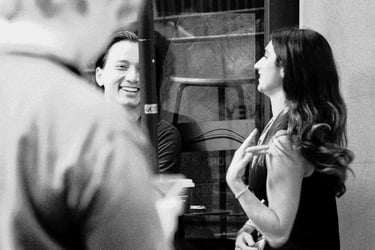
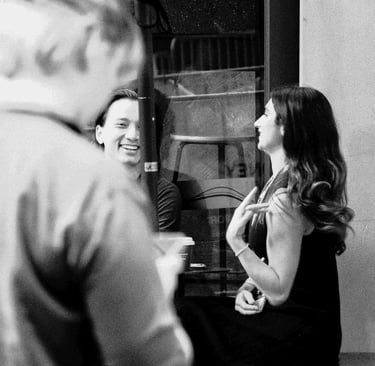
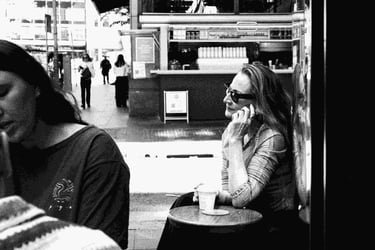
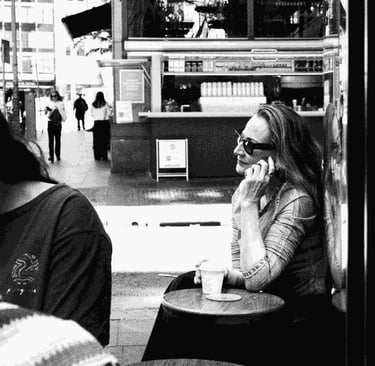
Fig. 1
Fig. 2
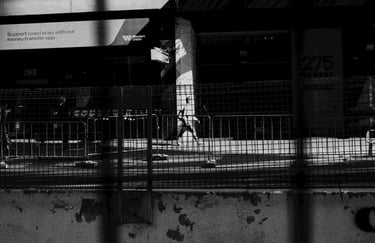
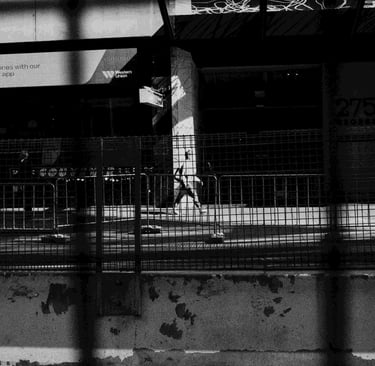
Fig. 3
Street Photography Ethics
Ethics: moral principles that govern a person's behaviour or the conducting of an activity (Oxford Languages).
I'll start by saying that after pondering whether street photography (ie candid photography) is ethical, you will have to make up your own mind, as I have.
Some people on the internet assert that we should ask for permission from a subject before photographing them. I suggest these people have never done any street photography as this is not feasible. Therefore they are, in effect, advocating for the demise of street photography. Once we ask for permission, it completely changes the dynamic and in essence, the photo is no longer candid. And imagine trying to ask for permission in a moving subject of multiple subjects.
What I do agree with is deleting a photo if someone objects to their image being captured. It's better not to argue but to just do it. I've had two people ask me to delete their photo in two years and most Sydney-siders are not worried about it. There was one man who was abusive when I included his wife in a shot I took of the street - that unsettled me for a while.
Different cultures have their own views on being photographed in public and when I travelled to India I found that generally Indians liked to have their photograph taken. On the other hand, I read that Moroccans are somewhat suspicious if they see a camera pointed at them.
I also read that we shouldn't exploit a photo, for example on social media. The term "exploit" is very much open to being defined in many ways. Some people would say that merely taking a photo of someone without permission is exploitative. My idea of exploiting someone captured publicly is by grossly misrepresenting the person.
"Street photography ethics involves balancing artistic freedom with respect for subjects by considering their privacy, dignity, and vulnerability." [1]
"Ethics should not be the force that holds you back from your vision; it should illuminate the path toward it." [2]
Ernest Sweet talks about "contextual integrity": the need to display and link the photograph within an ethical context, how it circulates, how it is interpreted; not just in a vacuum.
Critiquing Street Photos
I thought it would be useful to critique some street photos - in this case, a few of my own photos taken over the last two years. I've done this for two reasons:
When we can critique our own photos we will learn how to improve them
To see how I personally have improved over the past two years
The criteria I'm using for critiquing my images are:
Does it convey emotion?
Does it tell a story or is it aesthetic?
Is there a focal point?
Is it a well-composed piece, with distinct layers?
What is the use of light?
Is there what Henri Cartier-Bresson called a "decisive moment"?
Is it technically correct ... focus and exposure?
Is it original?
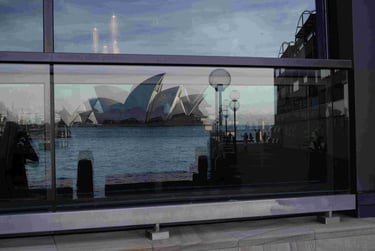
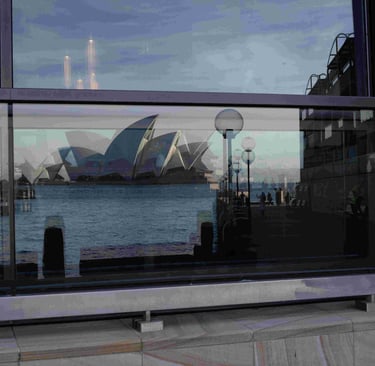
When I did some research for the topic of evaluation criteria, I kept coming up with "photos must tell a story". But it's not that simple, as street photos tend to fall into 2 categories: storytelling and aesthetic. The photo below left is the Sydney Opera House reflected in a restaurant window, with intentional camera movement. It's aesthetic/abstracted and has no story.
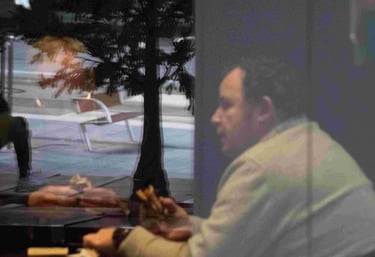
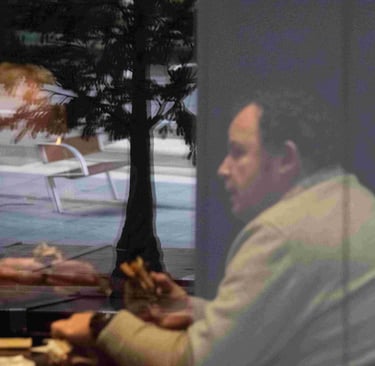
My photo below right could be said to be a mixture of both, as two men are visible, but the image is also abstracted.
So let's start the critiques of a handful of my photos.
My Photograph
My Critique
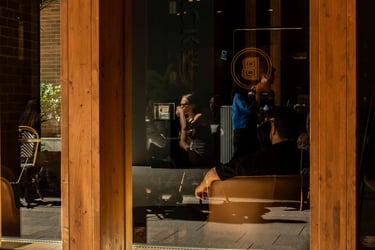
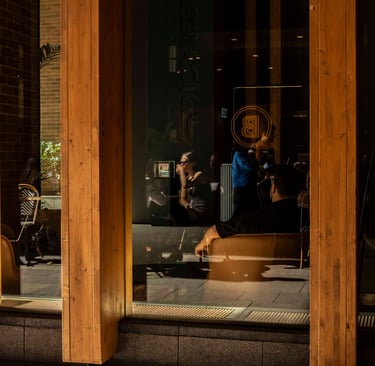
This doesn't convey emotion or a story. It's a pleasant-enough image of people behind glass in an office environment. Perhaps the person drinking from a cup is the focal point, given that she is illuminated and of mild interest. I think the composition is fine as the activity is framed between two pillars. The light, for me, is just right. There is no decisive moment, though there doesn't always have to be. Originality? Probably none.
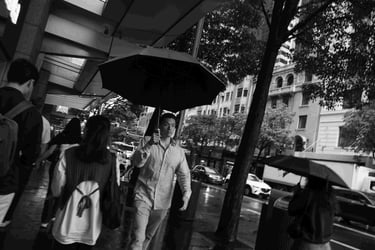
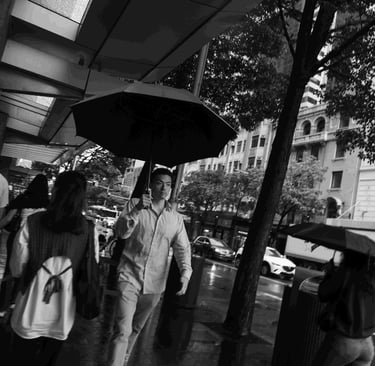
This doesn't convey emotion or a story, as per the image above. The young man with an umbrella is the focal point. The composition is well formed, bearing in mind that the photo is intentionally taken at an angle. I tend to like dark images, akin to black and white film. Of course, there is no decisive moment. There is little originality in this image.
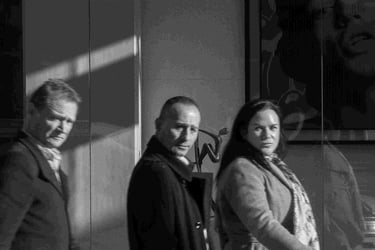
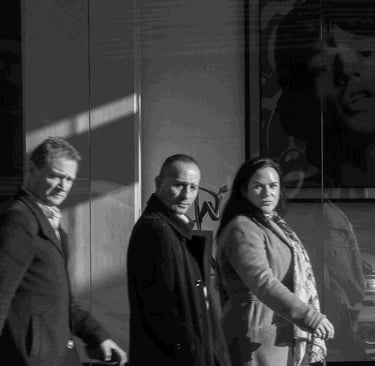
The concept of this photo is to capture three people, with different expressions, but who are facing in the same direction. The composition is fair, but would have been improved had the people been higher up the frame. I place the Autofocus (AF) Point in the centre of the frame on my camera. When I have to take a shot fast, I sometimes focus on the subject and expose immediately before rearranging the frame. This can lead to the subject being sub-optimally positioned.
There is no one focal point in this shot. I could say the decisive moment was when they were aligned . Originality...not very much.
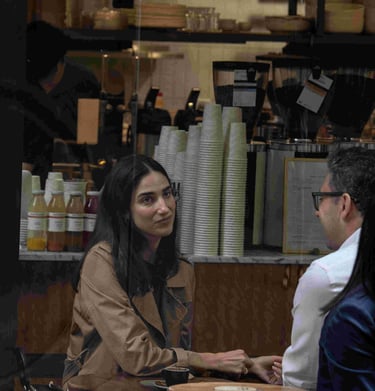
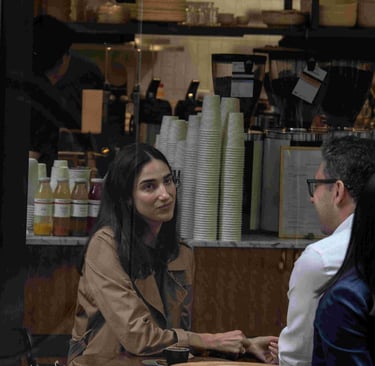
This is definitely a storytelling shot, but did it succeed? The man is speaking to the woman, who appears to be lost in thought. Perhaps she is contemplating what the man is saying. I think it conveys some emotion. The focal point is the woman's face but the composition is a bit off because of the gap to the left of her.
The photo doesn't have what Henri Cartier-Bresson called a "decisive moment", but is technically correct (focus and exposure).
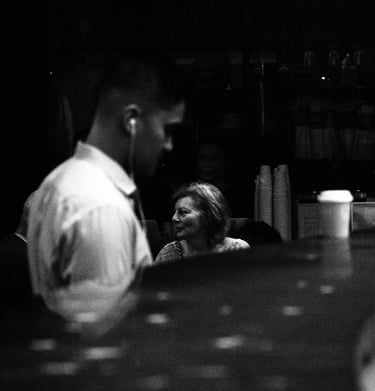
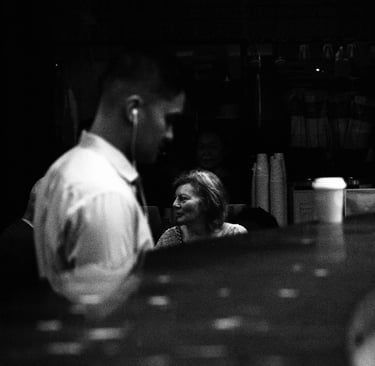
This is not a storytelling shot, but rather is an abstracted one. The man is looking at his mobile and the woman appears to be speaking to someone else who is hidden by the man in the foreground. The image is however, an example of a simple layered photograph with two layers plus background.
The focal point is the woman as she is in focus. The use of light and dark highlights the people and the coffee cup.
[1] AI Overview, Google, 1 November 2025; Keyword: street photography ethics
[2] Ernest Sweet, The Ethics of Street Photography – Part 3; https://streetphotography.com/the-ethics-of-street-photography-part-3/
Portfolio
Showcasing our best photography work for you.
Contact
Follow
trevor.reeves@iinet.net.au
0401 054 534
© 2025. All rights reserved.