Sydney Photography
What do you need for Street Photography?
You won't have to go out and buy another camera, though a compact one with 28-50mm focal length seems to be the camera of choice. There are several cameras sold as street cameras due to their small size and fixed lens. I've tried both a prime lens of 35mm and my 24-200mm zoom, and I prefer the zoom. This is because, for me, it adds flexibility such as capturing a street portrait from a distance. But the default focal length I use is 35mm, looking for a complex shot.
It's entirely up to you...try both if you have them and see what you prefer. You might change over time, perhaps starting with a Zoom and then moving to a Prime. It also depends on which culture you are shooting in, a Western one or a developing country. I will soon be travelling to Morocco and Turkey and I expect to be using my Prime.
I’m not prescriptive about camera settings or about street photography. I’ve discussed elsewhere what my definition of this genre is, and I’ve provided a brief overview of the exposure triangle. I use manual settings myself, other than focus, which I set to auto. When I am stationary for a period of time, for example, setting up a more complex photograph using layers, I set focus manually. Then I set the aperture to about f8 / f11 to enable a focus zone with a deep depth of field.
The main thing, as with any genre of photography, is to shoot and keep shooting. Also, read about street photography and view others' work. I find now that, even with a fast shot (perhaps the norm in street photography), my framing comes from my subconscious, and while not perfect, it’s good. It took a year or two before I achieved speed-framing.
Making Tracks
Sydney’s morning rush hour picks up at about 7.30am in the summer. That’s when ferries at Circular Quay begin to disgorge people at a higher rate, when office-dwellers alight from buses, and the Sydney Trains services also get busier on the City Loop.
I usually visit the city to shoot street photography three times a week and start at either Wynard station or the Circular Quay. As I get off the train, I feel the anticipation of gripping my camera and trying some “test” shots to get my brain into gear. I soon feel as one with my Olympus.
The inner city suburbs such as Surry Hills and Newtown draw me into their vibe occasionally.
A sunny morning, especially earlier, gives me the exciting contrast of light and dark and what I find particularly attractive is sunlight reflected from the windows of tall buildings. It has a muted, shimmering appearance.
Cloud cover for my Sydney street photography provides a diffused light, devoid of the contrasting light and dark. I’m at home in both settings, though sunny conditions are my favourite.
So, off I go. I’ll give you a secret: get off the train at Wynyard Station and take the exit towards Barangaroo. There is some very interesting form at this exit, together with many commuters exiting the station. Then you can explore Barangaroo, or head back to the CBD. When I’ve reached George Street I turn right and head uptown towards Martin Place. Surrounding and near Martin Place is the upmarket part of Sydney; then, walking further along the street, you will arrive at QVB and the Town Hall.
Martin Place runs from George Street through to Macquarie Street. The GPO, constructed in two stages beginning in 1866, boasts of an outstanding façade. The post office itself is now tucked into the section where Martin Place meets George Street.
You could continue up George Street into the
The business area of Sydney lies on the Eastern side of the city, bounded by Macquarie Street which has multiple historic buildings. I will often do a loop from the Quay up to Martin Place and back to the Quay via the business precinct.
Time of Day
A discussion about time of day for street photography in Sydney takes into account light and office hours. In discussing light I'm assuming a clear sky, not cloudy.
The longest days of the year are in December, when sunrise is around 5:30 am. In June, during the shortest days, sunrise is around 7:00 am. Bear in mind that if you want to photograph people as they go to work, you'll need to be out and about from 7.30 - 8.00 am. Earlier, if you want to photograph the Opera House and Harbour Bridge beforehand.
Between about 10.00 am and midday it's pretty quiet, then it gets hectic again for lunchtime. Up in the shopping quarter proper (Pitt St Mall, QVB and Town Hall), shoppers are out from about 10.00 am. The Chinese quarter is centred around George Street between the Town hall and Central Station.
As lunch time gives way to the afternoon and then into evening rush hour, you can do some candid photography after dark. For example, take a look at the Archibald Memorial Fountain in Hyde Park at night time.
My Thoughts on Global Street Photography
Street photography is carried out in different locations around the world, which affects the dynamics of the activity. Impacts of variable places are:
Changes in the subject matter - food, restaurants, local transport, clothes, etc
The cultural context. Beliefs, values, and social mores affect how a street photographer is welcomed to a country and how local people interact with that person. Compare Russian and Western values, for example.
Differences in lighting and the atmosphere affect photography. Compare the ambient light of London with that of Sydney.
Interaction with subjects varies in different cultures. Photographer Dan Ginn found that he was impressed with the friendliness of Asia and not so with parts of Europe, such as Germany. In numerous developing countries, foreign photographers frequently encounter more friendliness and curiosity - people may be more inclined to welcome photographers, even asking for their photo to be taken. This is what I found to be the case in India, where I took many street photos of smiling locals. In the West, strangers in the street are more guarded, and concerned about privacy.
By types of locations, I mean what might be called exotic and not exotic. For example, Australia and the rest of the West are not exotic, while Turkey, Morocco and India are. In exotic places, life is lived on the lanes and roadways. In the First World, life is lived in enclosed businesses, shops and homes. To a certain extent, we see life in coffee shops, sports grounds, and markets, but streets are no longer for sitting, playing games or chatting. Exotic locations are strange and adventurous from the point of view of countries in the West. Western countries, from the other's perspective, are formal and regimented.
The street photographers Jonathan Jasberg, Jorge Delgado-Ureña (Raw Society), and Gil Kreslavsky all produce superb, complex street images. But they build their advice, tutorials and photo examples around developing countries like Morocco, Turkey, India and Egypt. When I wanted to put their ideas into practice in Sydney, I immediately realised that it was very hard to do so. There's no street bicycle repairman next to an old man sitting in the street, with children playing, all in the same scene.
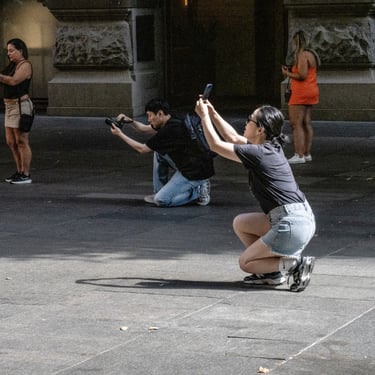
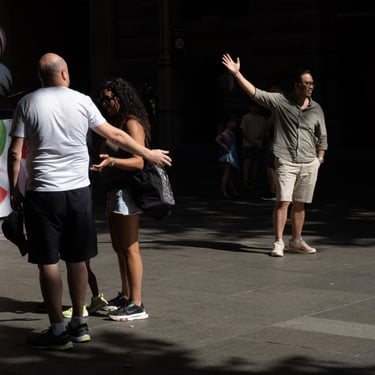
I have been trying to develop layering skills in Sydney, and opportunities are just about all based on several people walking along the street, two people chatting while others move behind them, or people waiting for their takeaway coffees outside a coffee shop. I'm not saying there's no chance to create a photo with layers, but that the richness of developing countries is not available.
Forms of Street Photography
Street photography form or type is not universally the same - the more I read about it, the more distinct forms I see. Let's consider the following five.
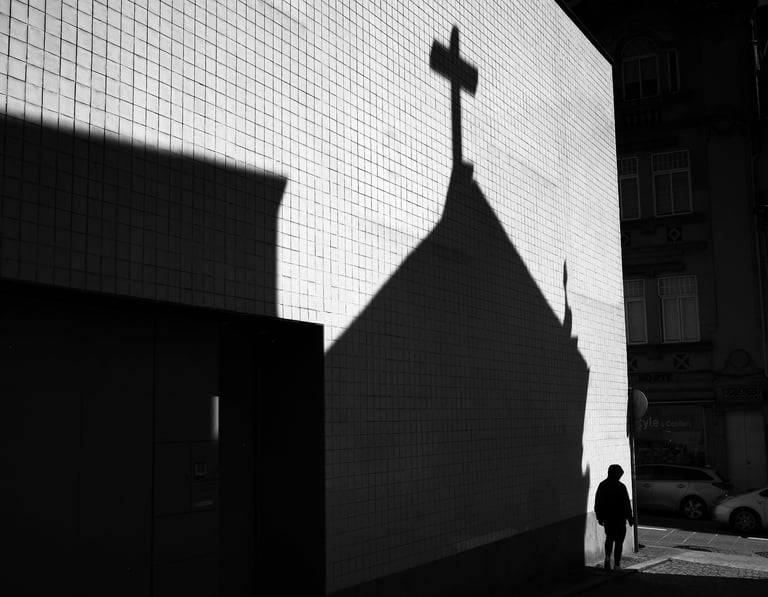
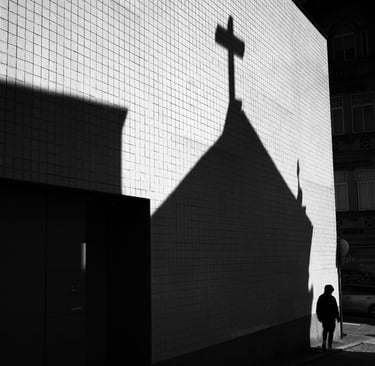
Rupert Vandervell inhabits a fairly narrow world of black and white / geometric high contrast images such as the one below. He is highly regarded for his distinctive, high-contrast, black-and-white street photography. His work is known for its "dark," "mysterious," and "thoughtful" atmosphere. I think it is repetitive and overly reliant on a specific aesthetic.
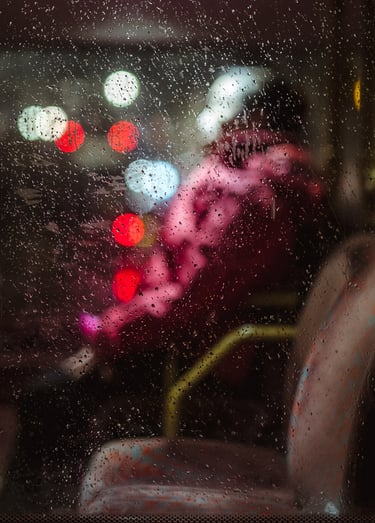
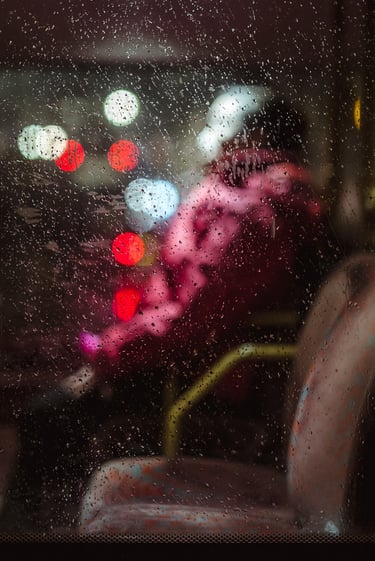
Josh K Jackson's preference is for colour - with a priority for blues and reds. Joshua lives in London and his work has been shown in the UK, USA and Europe. One of his quotes I like is "Marketing yourself (both online and offline) is very important. If you sit back and expect the phone to ring, it probably won’t." A sample image of his is:
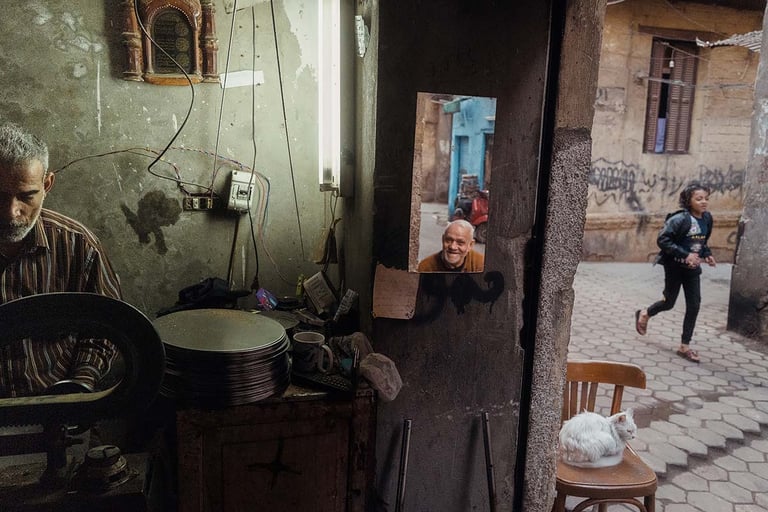
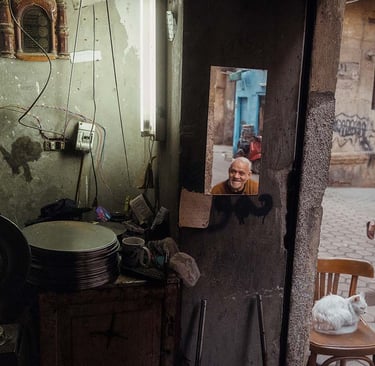
Jonathan Jasberg's primary point in his list of photographic elements is the need for what he calls "supporting characters". These are people who assist the main character in creating a complex street photograph. A quote from ChatGPT is: "A street scene that feels 'alive' often has multiple people interacting in different ways. Supporting characters make a street photograph feel more authentic, as they reflect the true bustle and diversity of urban life".
Since 2010 Jonathan has been living a nomadic lifestyle outside of his home country of the U.S.A. He is an award-winning street photographer with twelve years experience. Watch his video that introduces the seven most common photographic elements he uses in his work to create complex images. One of his images is shown below:
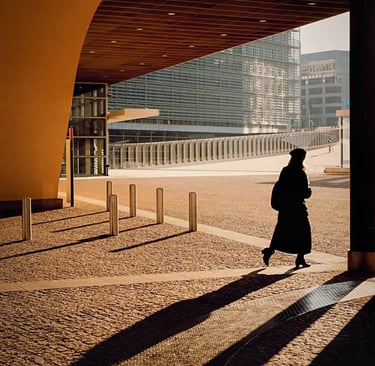
Frederic Axling is my next choice in depicting different forms of street photography. [121CLICKS] says "Whether it’s a lone figure walking down a sun-drenched street or the intricate patterns formed by light filtering through a building, Axling’s photos evoke a sense of wonder and curiosity. His work reminds us that even in the hustle and bustle of the city, there is magic to be found if we know where to look." One of his photographs is below:
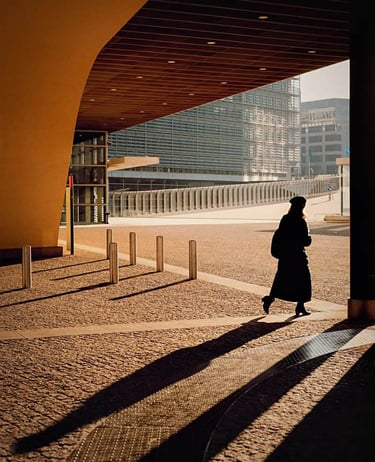
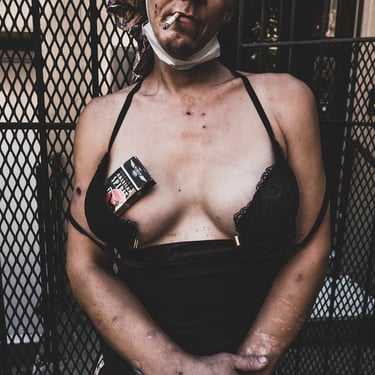
Last of what I call street photography forms is that of Suzanne Stein. She is a social documentary/street photographer currently in New York City and creates and exhibits "views concerning photographs of addicted, homeless or otherwise tormented people." Her photos are searing and once I started viewing her photos I couldn't stop for hours. She states that "After being shot at, assaulted and beaten on the street and generally being forced to fight for much of my output while in Kensington, shooting pictures in New York City as a street photographer is too easy." See examples of her work below:
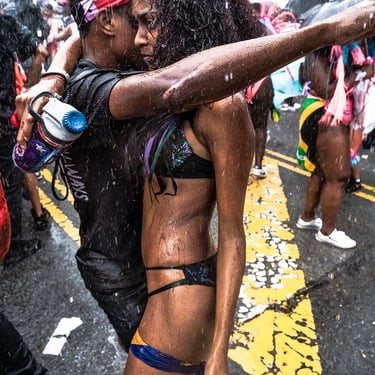
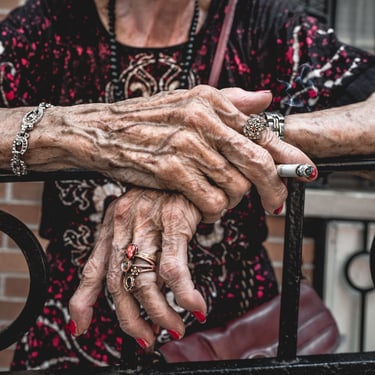
To fish or to chase?
In "Street" parlance, fishing is standing or in one spot and waiting for the catch to enter your frame. To chase is to be on the move, looking out for your prey.
What's a good place to hover?
One of my favourite places is coffee shops. People congregate outside chatting while waiting for their takeaway coffee. The Regiment coffee shop is my winner as it has wide, curved windows with seats outside for those "dining in".
How do you capture high-contrast black and white images with angular structures and with people?
Finding a good location is important of course. You need fully manual settings with a mixture of high shutter speed, a closed aperture, and a dark-shaded background with shafts of bright light. One technique is to fish for people entering the lit area from the surrounding darkness.
What is important in a camera?
The camera is not too important as long as it has your choice of favourite features. The latest cameras will have those. What is important is the way you use it - this comes with years of experience. Go out to shoot regularly. Search out the well-known street photographers like Billy Dinh, Jonathan Jasberg, Gil Kreslavsky and Saul Leiter, not to mention the masters such as Cartier-Bresson. Kreslavsky has some great training material online.
Are There Any Rules in Street Photography?
Portfolio
Showcasing our best photography work for you.
Contact
Follow
trevor.reeves@iinet.net.au
0401 054 534
© 2025. All rights reserved.